Effective Date: January 2026 · Last reviewed: August 2026
Purpose and Scope
This policy establishes standards for determining authorship on all scholarly outputs from this laboratory, including peer-reviewed publications, conference presentations, preprints, datasets, and software. All laboratory members, as defined in the Laboratory Code of Conduct, together with Soiyou Adventures personnel and other non-UF collaborators in respect of credit for work on laboratory outputs, must adhere to these guidelines1,3.4,5,6.
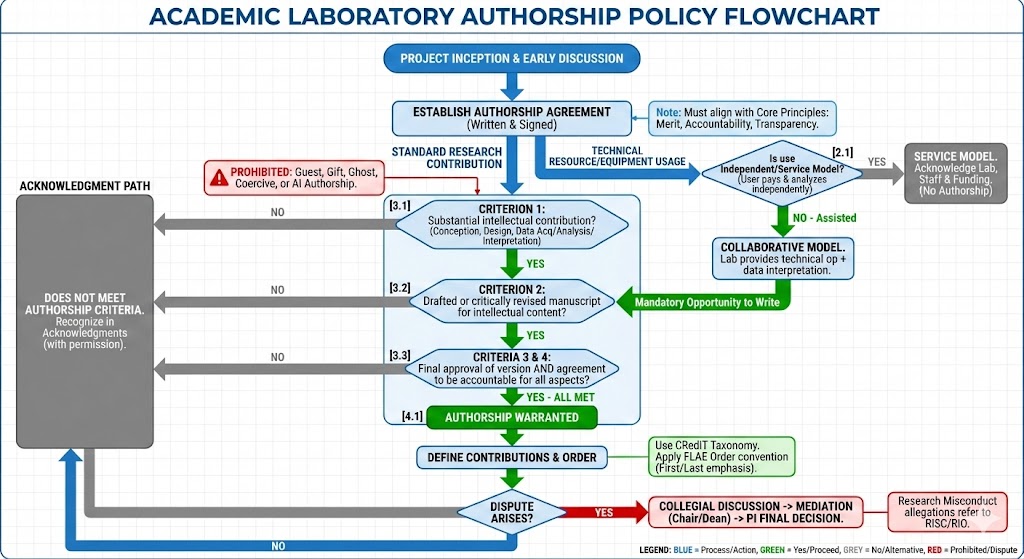 Click on the flowchart above to view it in full size.
Models of Engagement: Using Lab Resources
When external researchers wish to use our laboratory’s equipment (e.g., sequencing platforms, robotics, analytical instruments, computational resources), the relationship falls into one of two categories. The specific model is agreed in writing before access is granted, not after data exist. Where the model is unclear at the outset, the default is the Collaborative Model. See the Equipment Access and Shared Resource Policy.
1. The Service & Access Model (Acknowledgment Only)
- Definition: The collaborator requests access to equipment or resources but operates them independently.
- Requirements:
- Independence: The collaborator uses standard protocols and performs their own data analysis without technical input from our lab beyond instrument training.
- Access, training, consumables, and any charge: governed by the Equipment Access and Shared Resource Policy.
- Attribution: The Dutton Lab and the specific funding source for the equipment must be recognized in the Acknowledgments section of any resulting publications.
- Authorship Status: Authorship is not warranted under this model.
2. The Collaborative Model (Authorship Warranted)
- Definition: The project requires technical expertise held by Dutton Lab members. This includes modifying protocols for novel samples, designing custom hardware, developing new code, or interpreting datasets.
- Requirements:
- Intellectual Partnership: Lab members who supply the required technical expertise are intellectual contributors to the research.
- Opportunity to Contribute: Lab members involved in the technical work must be afforded the opportunity to contribute intellectually to the study design and data interpretation.
- Authorship Status: Lab members who supply the required technical expertise meet ICMJE criterion 1 and are prospective co-authors. They must be offered the opportunity to satisfy criteria #2 and #3, and co-authorship follows where all four criteria in the Authorship Criteria section below are met. Failure to offer that opportunity is a violation of this policy.
Core Principles
Authorship in this laboratory is governed by three principles: merit-based attribution ensuring that authorship reflects intellectual contribution; accountability requiring all authors to take responsibility for the integrity of published work; and transparency through early discussion, written agreements, and documentation of individual contributions1,7,8.9,10.
Authorship Criteria
For projects operating under the Collaborative Model, this laboratory follows the International Committee of Medical Journal Editors (ICMJE) criteria, 1,11. To qualify as an author, an individual must meet all four of the following criteria:
- Substantial contributions to the conception or design of the work; or the acquisition, analysis, or interpretation of data for the work; AND
- Drafting the work or reviewing it critically for important intellectual content; AND
- Final approval of the version to be published; AND
- Agreement to be accountable for all aspects of the work in ensuring that questions related to the accuracy or integrity of any part of the work are appropriately investigated and resolved1,11.
Individuals who do not meet all four criteria should be recognized in the Acknowledgments section rather than as authors1,11,12.
ICMJE provides that all individuals who meet the first criterion should have the opportunity to participate in reviewing, drafting, and final approval of the work; in this laboratory that opportunity must be offered1.
Contribution Roles and CRediT Taxonomy
This laboratory uses the Contributor Roles Taxonomy (CRediT), which defines 14 standardized roles including conceptualization, methodology, formal analysis, investigation, data curation, writing (original draft and review/editing), visualization, supervision, project administration, and funding acquisition13,14,15,16. Authors will document their specific contributions using CRediT categories for all manuscripts, and these contribution statements will be included in submitted publications13,14,15,16. All listed authors must still meet all four ICMJE requirements13,14,17.
Prohibited Practices
The following authorship practices are prohibited:
- Guest, gift, or honorary authorship: Inclusion of individuals who have not made substantial intellectual contributions to enhance prestige, increase publication likelihood, or as professional courtesy18,19,20,21.
- Ghost authorship: Intentional exclusion of individuals who have made substantial contributions, including appropriation of student or trainee work by faculty without proper attribution20,22,23,39.
- Coercive authorship: Demanding authorship based solely on position, financial support, or the provision of equipment/resources, without a corresponding intellectual contribution to the work24.
- AI Authorship: Listing artificial intelligence tools (e.g., LLMs) as authors. Authorship requires human accountability; AI tools must be disclosed as set out in the Artificial Intelligence Use Policy25,26.
These practices breach this policy and ESA publication standards. They are not research misconduct under UF Policy 14-004 unless the conduct also involves fabrication, falsification, or plagiarism18,19,20,24.
Author Order and Position-Specific Responsibilities
In ecology and related fields, author order typically follows a first-last author emphasis (FLAE) convention27,28,29,46.
- First Author: The individual who contributed most substantially to the research, typically leading study design, data collection and analysis, and manuscript preparation27,28,30,31.
- Last Author: Generally the senior investigator or principal investigator who provided conceptual guidance, supervision, funding, and laboratory resources, and who, like every author, is accountable for all aspects of the work under criterion 4 above27,28,29,30,31.
- Middle Authors: Individuals who made specific, substantial contributions in areas such as methodology, data generation, analysis, or interpretation, typically listed in descending order of contribution30,31.
- Corresponding Author: Responsible for manuscript submission, managing revisions, ensuring all co-authors meet criteria and approve the final manuscript, and serving as the point of contact for post-publication inquiries27,28,29,30. In this laboratory, the first author will serve as corresponding author unless the first author is unreachable, declines the role, or the journal requires an institutional contact27,28,29.
Authorship Discussions and Agreements
Authorship must be discussed at the beginning of each project, before substantial work begins7,8,32,33,34. The principal investigator or project leader is responsible for initiating these discussions. For projects involving multiple contributors, a written Authorship Agreement will be created and signed by all parties, documenting the proposed author list, specific CRediT roles, and decision-making processes32,33,34,35. This agreement is revisited before submission and after any change to the author list32,33,34.
Authors Departing the Laboratory
Individuals who leave the laboratory before manuscript completion retain their right to authorship if they have met the ICMJE criteria through their contributions to date6,36. However, the following expectations apply:
- Communication: Departing authors must provide updated contact information and remain responsive to communications regarding the manuscript.
- Manuscript Review: Departing authors must fulfill their obligation to review and approve the final manuscript (ICMJE criterion #3) within 2-4 weeks for initial drafts and 1-2 weeks for revisions. These periods are indicative, not disciplinary, and are extended on request; a request needs no reason and the laboratory does not ask for one.
- Continued Contribution: If substantial additional work is required after departure that changes the scope or conclusions of the study, authorship order may be re-evaluated in consultation with all contributors.
- Opt-Out: Any author may opt out of authorship for any reason by notifying the corresponding author in writing. If you would like a third party present or informed, the Department Chair, the UF Ombuds, and the Graduate School are available; that is your choice, not a requirement. Where someone opts out, they are offered acknowledgment of their contributions in the Acknowledgments section and are named only if they consent. Declining acknowledgment as well as authorship is permitted and requires no reason. Soliciting an opt-out from someone you supervise is a violation of this policy.
- Completion after departure: Lead authors who leave the laboratory are expected to complete manuscript preparation within 6-12 months after departure, depending on the project’s stage. Reassignment of lead authorship requires the written agreement of the original lead author or, failing agreement, a determination by the Department Chair. Written notice and a stated period to resume work must precede any proposal to reassign. That period pauses whenever the manuscript is awaiting comments from the Principal Investigator (who returns comments within four weeks), and is extended on request. A request for extension needs no reason, and the laboratory does not ask for one. Loss of lead authorship never removes co-authorship where criterion #1 is met, and the laboratory must offer the opportunity to satisfy criteria #2 and #3.
Rights and Responsibilities of Trainees
Graduate students, postdoctoral researchers, and undergraduate researchers have the right to authorship on publications to which they have made substantial intellectual contributions meeting ICMJE criteria6,36,37,38,39. Students are presumed to have primary authorship of work arising from their thesis or dissertation research, provided they lead the manuscript preparation. Faculty may not appropriate student work without proper attribution6,36,38. Faculty are responsible for mentoring trainees on responsible authorship practices and must not penalize trainees for raising concerns6,36,37,38.
Early-Career Researcher Protections: Undergraduate students and technicians who make substantial intellectual contributions meeting ICMJE criteria must be included as authors31,39,40. Routine technical work (e.g., media changes, running standard assays) does not warrant authorship. Students and technicians who contribute to experimental design, data interpretation, or manuscript preparation must be listed as authors where they meet all four criteria and acknowledged where they do not31,39,40.
Preprints and Early Dissemination
Preprint posting is permitted, subject to the following guidelines:
- Consensus Required: All authors must agree to preprint posting before submission to servers such as bioRxiv, medRxiv, or EcoEvoRxiv47.
- Timing: Preprints may be posted at any time before or during journal submission, subject to co-author approval and journal policies.
- Updates: Corresponding authors are responsible for updating preprints with links to the published version upon acceptance48.
- Authorship Changes: Author lists on preprints should match the intended journal submission. If authorship changes between preprint and publication, updates to the preprint should note these changes.
- Acknowledgment: Preprint DOIs are cited in related presentations and grant applications.
Data, Code, and Research Materials Authorship
Authorship on datasets, software packages, and other research products follows the same ICMJE criteria as traditional manuscripts. Supporting information and data-paper preparation follow ESA guidance41:
- Data Papers: Individuals who make substantial contributions to data collection, curation, quality control, and documentation may warrant authorship on data descriptor manuscripts.
- Software and Code: Authors of computational tools should include those who contributed substantially to design, implementation, testing, documentation, and ongoing maintenance.
- Repositories: Data and code deposited in repositories (NCBI SRA, EDI, Zenodo, and GitHub, per the Data and Code Management Policy) must name contributors in metadata and README files, even if formal authorship is not applicable.
Collaborative and Multi-Institutional Projects
For external collaborations, the written Authorship Agreement required above is established at the outset and explicitly references dispute resolution processes4,5,8. Multi-institutional consortia should list individual authors who meet ICMJE criteria rather than the consortium name alone, although consortium names may be listed separately25. Co-first authorship (“these authors contributed equally”) and co-senior authorship (“these authors jointly supervised this work”) are both permitted, are documented in the authorship agreement, and are indicated in the publication with the notation the journal uses27,28.
Use of Artificial Intelligence Tools
AI use is governed by the Artificial Intelligence Use Policy, which sets disclosure placement and permitted uses. In summary:
- No AI Authorship: AI tools cannot be listed as authors, as they cannot take responsibility for the work25,26.
- Disclosure Requirements: Placement is set by the Artificial Intelligence Use Policy: AI applied to data analysis or research design is described in the Methods section, and in all cases a disclosure statement naming the tool, version or date, purpose, and extent of use appears in the Acknowledgments2,25.
- Author Responsibility: Authors are responsible for all content, including AI-generated text, figures, or code. All AI outputs must be verified before submission2,25.
- Data Analysis: AI tools used for data analysis are described in the Methods section like any other analytical tool, with version numbers and parameters specified.
Post-Publication Responsibilities and Corrections
All authors share responsibility for the published work and must respond to post-publication inquiries:
- Corrections and Errata: If errors are discovered after publication, authors must submit corrections or errata through the journal’s established processes42.
- Retractions: In cases of errors that invalidate the conclusions, or research misconduct, authors must support retraction. The corresponding author coordinates this process with the journal editor42.
- Correspondence and Inquiries: All authors must respond to inquiries about methods, data, and interpretations. The corresponding author serves as the primary contact but may delegate specific queries to co-authors with relevant expertise1.
- Data and Materials Sharing: Authors must comply with journal policies and funder mandates regarding data and materials sharing. Refusal to share is a breach of this policy and of journal and funder terms. It is not, by itself, research misconduct under UF Policy 14-004, which reaches only fabrication, falsification, and plagiarism.
Dispute Resolution
Authorship disputes should first be resolved through direct discussion among the involved parties4,5,43,44. If resolution cannot be achieved within the research group:
- The matter should be escalated to the Department Chair or an uninvolved senior faculty member for mediation4,5,43,44.
- If mediation is unsuccessful, the matter may be referred to the College Dean or the University Ombuds.
- Where the Principal Investigator is a party to the dispute, the PI recuses and the decision rests with the Department Chair or a Chair-appointed senior faculty member with no involvement in the work, subject to the referral in step 2. The UF Ombuds is available at any stage and does not require the earlier steps to be exhausted first. The Research Integrity Officer is the route only where the allegation includes fabrication, falsification, or plagiarism.
Note: Research misconduct means fabrication, falsification, or plagiarism. Authorship disputes, including guest, gift, and ghost authorship, follow the pathway above and are not research misconduct unless the conduct also involves fabrication, falsification, or plagiarism. Misconduct allegations are referred to UF Research Integrity, Security & Compliance (RISC) and the Research Integrity Officer (RIO)4,5,22,43.
Acknowledgments
Individuals who contributed to the research but do not meet all four ICMJE authorship criteria must be acknowledged in the manuscript’s Acknowledgments section with their permission1,11. This includes funding acquisition, general supervision, administrative support, technical assistance, or writing assistance (including AI tools) without intellectual contribution. Acknowledged individuals must consent to being named1.
Compliance and Review
This policy aligns with ICMJE recommendations, CRediT taxonomy, Ecological Society of America guidelines27,45, and UF research integrity standards. All laboratory members are required to read and acknowledge this policy upon joining and annually thereafter. This policy is reviewed annually. Violations are handled within the laboratory and through the Dispute Resolution pathway above. They are referred to the UF Research Integrity Officer only where the conduct also involves fabrication, falsification, or plagiarism.
Policy Acknowledgment
Member Name (print): ___________________________________
Member Signature: ___________________________________
Date: __________________
All laboratory members must read and acknowledge this policy upon joining the laboratory and annually thereafter.
Confirm by email, or sign a printed copy if you prefer.
References
- International Committee of Medical Journal Editors (ICMJE). Defining the Role of Authors and Contributors.
- Northeastern University, NU-RES Compliance. Standards for the Use of Artificial Intelligence in Research at Northeastern.
- Yale University. Guidance on Authorship in Scholarly or Scientific Publications. 2016.
- University of North Carolina at Charlotte. Authorship Policy and Resolution Procedures (UP 318). Approved 2021; revised 2025.
- Washington University in St. Louis. Dispute Resolution in Authorship. 2009.
- Graduate Council of the Faculties, University of Pennsylvania. Fairness of Authorship Credit in Collaborative Faculty-Student Publications (PhD, AM, and MS Students).
- Harvard Medical School Ombuds Office. Authorship Guidelines (PDF).
- Duke University. Duke University Policy on Authorship (PDF). 2008.
- Rennie D, Yank V, Emanuel L. When authorship fails: a proposal to make contributors accountable. JAMA. 1997;278(7):579-585.
- Venkatraman V. Conventions of Scientific Authorship. Science (Science Careers). 2010. doi:10.1126/science.caredit.a1000039.
- International Committee of Medical Journal Editors. Recommendations for the Conduct, Reporting, Editing, and Publication of Scholarly Work in Medical Journals (PDF). Updated January 2026.
- American Medical Writers Association. ICMJE Authorship Guidelines: Defining Roles and Acknowledging Non-author Contributions. 2026.
- NISO. CRediT (Contributor Roles Taxonomy).
- Frontiers. Frontiers adopts CRediT to enhance clarity in research authorship. 2023.
- Wiley Author Services. CRediT (Contributor Roles Taxonomy).
- Elsevier. CRediT author statement.
- Taylor & Francis Author Services. CRediT at Taylor & Francis.
- Harvey LA. Gift, honorary or guest authorship. Spinal Cord. 2018.
- The Embassy of Good Science. Honorary or gift authorship.
- UK Research Integrity Office. Good practice in research: Authorship (PDF). v1.0, 2017.
- Council of Science Editors. 2.2 Authorship and Authorship Responsibilities. Updated June 2020.
- Office of Research Integrity, U.S. Department of Health and Human Services. Plagiarism and Authorship Disputes.
- Stanford University, Research Policy Handbook 1.5. On Academic Authorship. 1985.
- Ohio State University, Office of Research Compliance. Authorship Guidelines (PDF). 2021.
- GigaScience (Oxford Academic). Authorship Guidelines. Includes group authorship.
- Nature Ecology & Evolution. Authorship.
- Weltzin JF, Belote RT, Williams LT, Keller JK, Engel EC. Authorship in ecology: attribution, accountability, and responsibility. Frontiers in Ecology and the Environment. 2006;4(8):435-441.
- Duffy MA. Last and corresponding authorship practices in ecology. Ecology and Evolution. 2017;7(21):8876-8887.
- Duffy M. Last and corresponding authorship practices in ecology: Part 1. Dynamic Ecology. 2016.
- Brown University, Division of Research. Authorship and Related Policies.
- Northeastern University. Authorship/Assignment of Credit.
- Appalachian State University. Authorship Agreement Form (template, .docx).
- UNSW Sydney. Authorship Agreement Form (PDF). 2025.
- University of North Carolina at Charlotte, Graduate School. Authorship Agreement (PDF). 2024.
- University of Pittsburgh, Institute for Clinical Research Education. Authorship Agreement (template, .docx).
- Norman MK, Proulx CN, Rubio DM, Mayowski CA. Reducing tensions and expediting manuscript submission via an authorship agreement for early-career researchers: a pilot study. Accountability in Research. 2023;30(7):379-392.
- University of Colorado Boulder. Graduate Student Bill of Rights and Responsibilities.
- Office of Research Integrity, U.S. Department of Health and Human Services. Authorship in Faculty-Student Collaborations.
- Science. Don't make early career researchers 'ghost authors.' Give us the credit we deserve. 2021.
- Honoré M, Keller TE, Lindwall J, Crist R, Bienen L, Zell A. Contributions Made by Undergraduates to Research Projects: Using the CRediT Taxonomy to Assess Undergraduate Research Experiences. Scholarship and Practice of Undergraduate Research. 2020;4(1):41-51.
- Ecological Society of America. Manuscript Preparation Guide (PDF). Last modified March 2025.
- NIH Office of Intramural Research. NIH IRP Authorship Conflict Resolution Policy. 2023.
- Harvard Faculty of Arts and Sciences and SEAS. Guidelines on Authorship and Acknowledgement. October 2025.
- U.S. Department of the Interior. Frequently Asked Questions Regarding Authorship in Scientific and Scholarly Work Products. 2021.
- Ecological Society of America. Code of Ethics. Amended May 2021.
- Fox CW, Ritchey JP, Paine CET. Patterns of authorship in ecology and evolution: first, last, and corresponding authorship vary with gender and geography. Ecology and Evolution. 2018;8(23):11492-11507.
- openRxiv. bioRxiv Submission Guide. States that all authors must consent to deposition.
- International Committee of Medical Journal Editors. Overlapping Publications. Section III.D.3, Preprints.